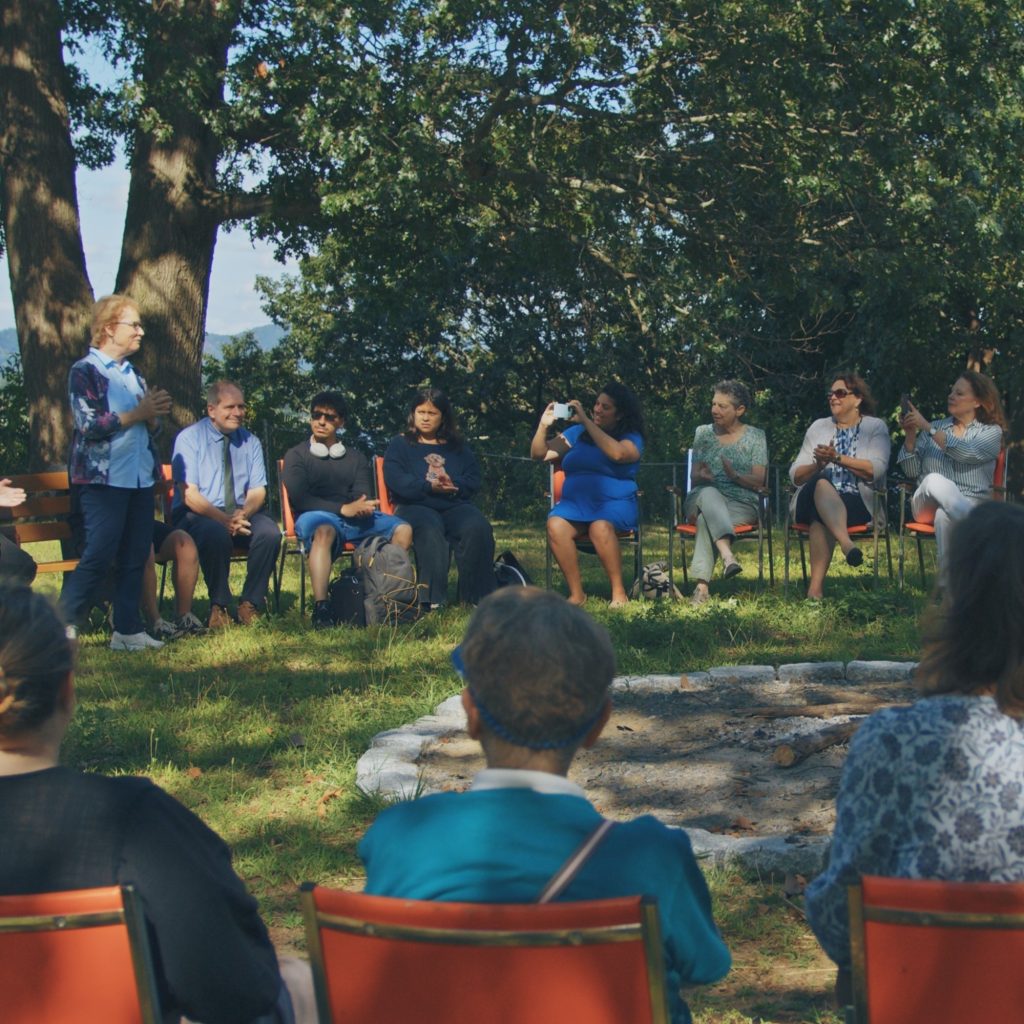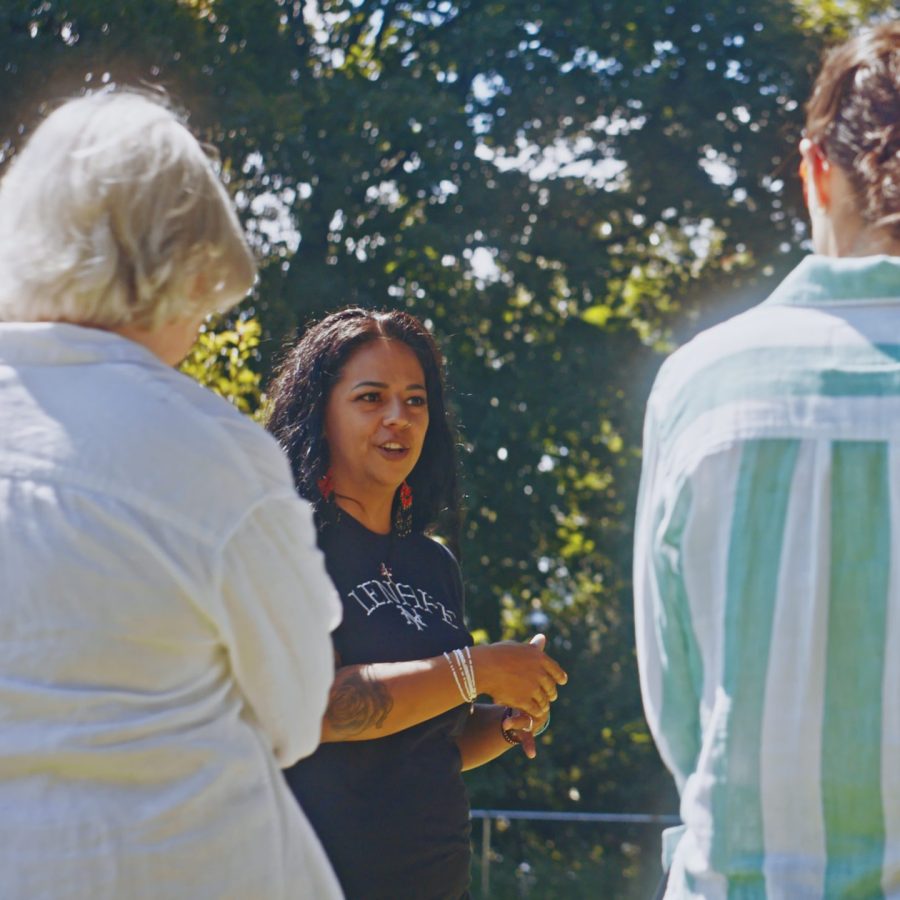
Wanonah Kosbab and Shawn Stevens are educators from the Stockbridge-Munsee Band of Mohicans. With grants from The Trust’s Mortimer Fund for Native American Children, they created a program that brings young people from their reservation in Wisconsin to visit their ancestral homelands in Westchester County for 10‑day cultural and leadership immersions centered on intergenerational healing. The retreats are hosted by the Dominican Sisters of Hope at the Center at Mariandale in Ossining, New York.
Moments of Spirit, Leading Back to the Red Road
Wanonah Kosbab serves as co-director of the nonprofit Red Road Reclamation. She is an Indigenous cultural facilitator, trauma healing guide, ordained minister, and artist.
“Growing up, I found Spirit first in church. Then I found Spirit in ceremony. And that’s where I realized that it’s the same Spirit.
We wanted to do these programs because we believed we could empower our youth. The programming came from Shawn and me discussing what kept us from drugs and alcohol, what helped us walk the Red Road when others were struggling. We realized it was moments of culture and tradition where we experienced ceremony and had the feeling of Spirit. We needed to create more moments of Spirit for our young people, so we could keep reminding them to come back to this Red Road.
This is in our teachings: that the teachings are given to us not to keep for our own, but to share with others. If you’re in tune with Spirit, you can feel that aching when someone has taught you something, and then someone magically shows up with this problem that you now have a solution to.
We started taking traditions like this, that are just so beautiful and made such a difference in our lives, and putting them into programming.
In this society, we’re taught that we stand alone, but we were never meant to be that way. We take care of all children as our own. When we’re there for each other, and we model and teach that, we see the kids start taking care of each other—all the way down the line.”
The Spirit of Our Ancestors
Shawn Stevens serves as board chair for the nonprofits Red Road Reclamation and Homelands PowWow. He is a licensed Tribal Elder with the Stockbridge-Munsee Band of Mohicans, cultural and historical educator, spiritualist, and storyteller.
“My first time in the homeland was amazing. I felt the spirit of the land, the spirit of our ancestors, resonating everywhere, no matter where I looked: down the highways, in the woods, by the river. It never left me. I said to myself, ‘I would really like to see the rest of our people also make that journey home.’
I’ve done a lot of work reclaiming language and culture and trying to heal intergenerational trauma. It was a revelation, when I realized how much it affects us all. Often, we have no idea about the scars we carry, that were inflicted on our ancestors.
During the immersions, we talk with the youth about intergenerational trauma, about the issues that we have in our families and on the reservation. We talk with them about how they are the future, and they’re the ones who are going to make a change.
It’s hard for youth to stand up and have that voice, especially when you’re brought up in families that were basically taught by the mission schools that you don’t speak out, you don’t rock the boat, or you’ll be punished. We’re finding ways of empowering them and letting them know that they don’t have to just get in line and do as everybody else does.
It was amazing to see the growth from the beginning of the immersion to the end. We saw them come back home with a new sense of wanting to change things, not only within ourselves, but also with environmental issues.
They’re sharing their stories on the reservation, and it’s a big, big deal, and it’s starting to grow. And I’m very happy, very proud, that we’re getting more people out here to be on our ancestral lands. They’re getting to know people out here, and they’ll make lifelong connections.
We want to keep that going, these communities coming back together. And not with hatred or animosity, but with peace and love and looking toward a good future with one another.”
Read more here about the youth immersions program and the partnerships behind it.
Watch short documentary videos about the immersions below.
Special thanks to producer Joe Plante of New Media Storytellers.